
Buying Guides
Choosing a cast iron casserole
Size, shape and enamel — how to choose a cast iron casserole you will still be cooking in thirty years from now.
A practical route to deeply golden roast potatoes, using the steady heat of cast iron and a method designed for a South African Sunday table.
By Cookin · 24 September 2026 · 3 min read
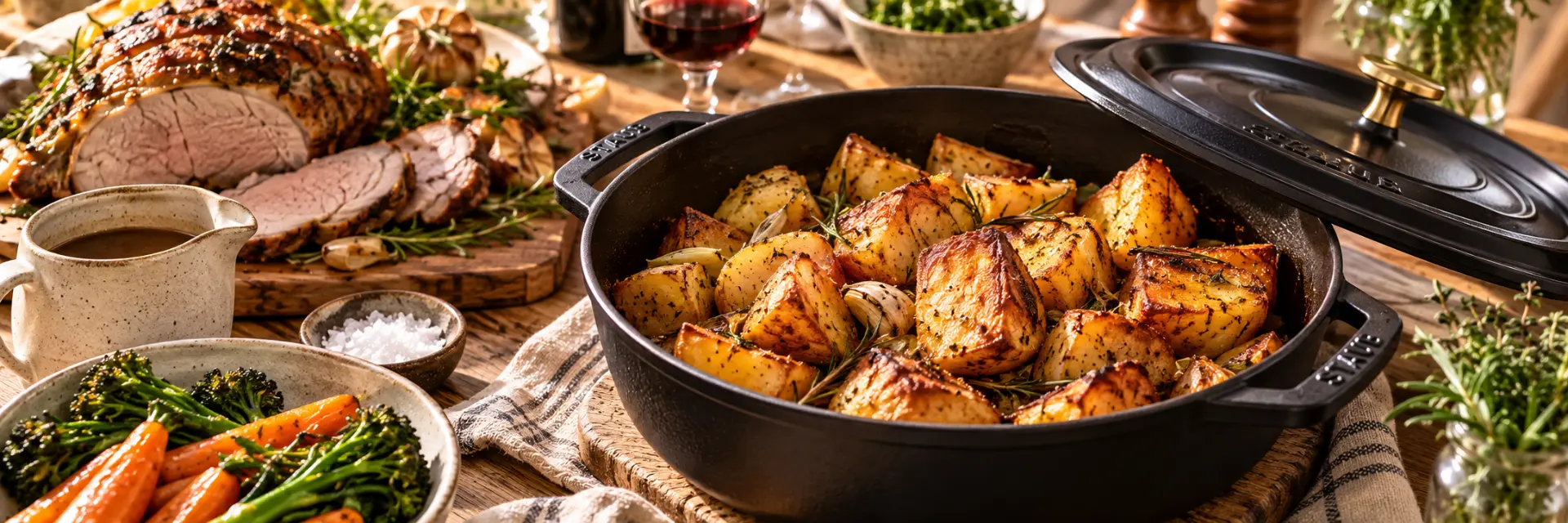
The best roast potatoes are a contrast: a craggy, well-coloured shell around a soft centre. Cast iron helps because it stores heat and recovers quickly when cool potatoes are added. The trade-off is space. A heavy casserole gives excellent contact heat only when the potatoes sit in a loose single layer rather than steaming in a crowd.
Use a floury or all-purpose potato sold for roasting rather than a waxy salad potato. The variety available changes through the year, so ask your greengrocer or check the bag. Pieces of roughly 5cm cook at a similar rate and leave enough surface to roughen after parboiling.
A broad cast-iron base transfers stored heat directly into the cut faces, encouraging colour where potato meets pan. Use the casserole without its lid: trapped steam is useful for a braise, but it works against a crisp roast. The vessel stays very hot at the table, so keep it on a proper trivet and leave an oven cloth beside it.
Parboiling starts the centre; a brief shake in the drained pot creates the rough exterior that catches hot fat. Once the potatoes reach the cast iron, give each piece contact with the base. Turn them once the underside has formed a proper crust rather than repeatedly disturbing them.
Provisional recipe
Roast potatoes
To finish
Heat the oven to 220°C conventional or 200°C fan, with a rack in the upper-middle position. Peel the potatoes and cut them into even pieces of roughly 5cm.
Put the potatoes into a large saucepan, cover with cold water and season the water. Bring to the boil, then simmer for an indicative 8–10 minutes, until the outer edges are tender but the centres still offer resistance to a knife.
Drain thoroughly and leave the potatoes in the colander for 3–5 minutes so surface steam can escape. Return them to the dry saucepan, add the measured fine salt, cover and shake gently to roughen the edges without breaking the pieces apart.
Add the oil to a broad 4.8L cast-iron casserole and place it, uncovered, in the oven for about 8 minutes. Using dry oven gloves, set the hot vessel on a heatproof surface. Carefully add the potatoes and turn each piece in the oil, arranging them in a loose single layer with a cut face against the base.
Roast uncovered for 25–30 minutes without disturbing them. Turn each potato onto a paler face, add the garlic and rosemary, then roast for a further indicative 25–35 minutes. Rotate the vessel once if the oven colours unevenly.
The potatoes are ready when deeply golden on several sides and completely tender through the centre. Remove the rosemary stalks, season with black pepper and taste before adding flaky salt.
Leave the potatoes uncovered for about 5 minutes before serving. This lets excess steam escape while the cast iron keeps them warm. Serve from the casserole only on a sturdy trivet, with both handles treated as hot.
Notes
Where to look next
Buying Guides
Size, shape and enamel — how to choose a cast iron casserole you will still be cooking in thirty years from now.

Buying Guides
What each cookware material is genuinely good at, where it fails, and the three-pan combination that covers almost every kind of home cooking.

Buying Guides
A short, honest equipment list for a first flat, a self-catering rental or an Airbnb kitchen — what to buy well, what to buy cheaply, and what to skip entirely.